Book Review: “The Book Thief” by Markus Zusak

The Book Thief

By Markus Zusak

the book thief

This is a beautiful book. Exquisitely heart-breaking.

Germany is in the hands of the Führer, and Liesel Meminger is a book thief. Both Hitler and Liesel know that words have power. Words can save a person’s soul or inspire people to do unspeakable things.

In this novel, Markus Zusak is our omnipotent and benevolent wielder of words. His ability to capture the imagination is powerful and gentle. Master of the concise metaphor. I was drawn into the Book Thief’s world within the opening paragraphs and could not put it down. It begins simply and proceeds in uncomplicated terms. Its gentle twists and turns develop into a fully formed and complex story without you even realising. But I will not allow myself to over-analyse; I wish to leave this story unbroken.

Liesel stole books. And Death was her friend. Discover the rest for yourself.

Re“Vamp”ing The Classics: Book Vs. Screen

For anyone who missed it being published on Clamour’s website, here’s the article again (Click here to view on Clamour):


Are we too precious about the classics, or is the literary canon being sullied by modern adaptation and blasphemous reinvention?

Is this a question of artistic integrity or snobbery? Or is it nothing so high-flown, and merely a signal for change in social approaches to literature and the arts in general? In an age where the big screen is constantly beating books in the popularity contest, the relationship between these two art forms is changing. Slap a new cover on an old book, with the familiar faces of a recent screen adaptation, and that book will fly off the shelves that before had only been gathering dust.

Two recent examples that have undergone a screen ‘revamp’ are “War & Peace” by Leo Tolstoy, in the much acclaimed BBC adaptation in January of this year, and the Jane Austen inspired “Pride & Prejudice and Zombies” by Seth Grahame-Smith, released as a feature film in February.

book v screen V1 small

Reworking literature is not a new idea. Satire has always existed, ever since there were people making art, from Ancient Greece to the present day. Satire, parody, homage and pastiche – the oldest forms of criticism or veneration. What, then, makes these two examples of particular interest? What new trend are they evidencing? Continue reading

Book Review: “The Noise of Time” by Julian Barnes


The Noise of Time

By Julian Barnes

noise of time book

5-stars

I was already a fan of Julian Barnes before I read this book. But I was familiar with his more overtly humourous titles – “Flaubert’s Parrot” and “A History of the World in 10 1/2 Chapters”. While this new novel is still unmistakably stamped with Barnes’ wry style, it is of a blacker kind than I had previously encountered.

“The Noise of Time” tells the story of real life Russian composer Dmitri Shostakovich, during the twists and turns of the Russian Revolution. It is a tale of one man’s struggle, and the problem of artistic freedom versus artistic integrity. You might think – or hope – that the first will bring about the second. If the artist is free to create as he wishes, then surely what he produces will, if he possibly can, be naturally something with integrity. Not so, when the grip of Communism has so thoroughly distorted the nature of what it means to be free.

“Let Power have the words, because words cannot sustain music. Music escapes from words: that is its purpose, and its majesty.”

The distortion of language, of terms like freedom and truth, make the role of musician in our historical protagonist an interesting lens through which to view Russia at that time. Even if words have been betrayed, perhaps there is still hope for music. Perhaps music can be heard above the din of propoganda, and deliver secret messages to those willing to hear. But if Shostakovich’s music could reach worthy ears, would political “truths” and the ghastly practise of Revisionism so dismantle the Russian landscape and its people, that both the man and his music would be drowned out by the noise of time?

And in amongst the big political and cultural questions Continue reading

Book Review: “A Whole Life” by Robert Seethaler

The first book recommended to me by the staff at Waterstones:

a-whole-life

A Whole Life

by Robert Seethaler

5-stars

Neither the economy of language nor the physical coldness of the landscape do anything to dampen the warmth of feeling woven throughout this short novel – both bitter and sweet.

There is a frankness and plainness to the words that creates a world without over-filling it. You feel that every word is necessary. It is ungarnished. The infrequent dialogue is made the more potent by its scarcity and blunt truthfulness. You feel as if these are memories hewn by time to their most composite form; memories whose accuracy encompasses all that is needed, all that is most affective. Our guide, Egger, is a man of fortitude and quiet strength. His many trials, though tragic, are without the solipsism of tragedy.

“But each time the rumbling died away and the clear cries of the jackdaws could be heard again.”

He limps through life as best he can, and his quiet, persistent trudging is honourable and life-affirming. An unstudied lesson in philosophy; gently shown, not taught. We are blown through his snowy valley as quiet observers. In Egger’s solitude, we are not made to feel like intruders, but rather to join with the quiet breath of the mountains that are his constant companions. And for our silent companionship, his unimposing wisdom is our gift.

“A Whole Life,” in less than 150 pages. As you read, the sense of empathy settles quietly within, without your noticing and Egger, though often a stranger within his own story, is not a stranger to you for long.


Alphabetty Spaghetty Review of The Tobacconist by Robert Seethaler

tobacconist-3

Job Success -The Cover Letter Resolution

As I wile away the time between being an Almost-Adult and being a Finished Adult – perish the thought – I have gotten myself a part-time job in a bookshop. It’s not a life time goal, but a facilitator for the many I hold. For, like it or not, money makes this giant sphere rotate around an off-vertical axis. Or something more catchy than that. So, I’ve got a job at a bookshop, which is already infinitely better than counting money in a department store. Books are my thing.

As some of you may recall from previous posts, the process of filling out job applications and writing covering statements is a task I much lament. I therefore took a bit of a different tack with my cover letter on this occasion and, evidently, it worked…


To Whom It May Concern,

To be blunt, I really want to work in [Big-Brand Bookshop]. I’m looking for a part-time position with flexible hours, and I’m happy to work weekends, and a position in your shop would be perfect for me.

I’ve been a book lover ever since I can remember. I remember the first book I ever read; it was called Look, and on each page was one word, “Look.” It was my first book, what do you want from me? I remember the first time I read a whole book in one day. It was Fantastic Mr Fox, by Roald Dahl – that’s a big achievement when you are seven years old. I remember my older sister reading Mr Men books to me when I couldn’t sleep. I remember racing against my sister to finish the latest Harry Potter. I remember staying up all night, because I couldn’t put down The Handmaid’s Tale, by Margaret Atwood. I remember the sense of discovery I felt when Continue reading

Cinderella Pantomime Tour – Christmas 2015

A touring pantomime of “Cinderella” around care homes and primary schools. No one could ever say this job was easy.

We played to audiences who were asleep; dementia patients, who heckled vehemently; special needs patients, who grabbed performers mid-song; crying women; cheeky men; bored carers; unhelpful carers; rude carers; delightful carers; enthusiastic carers; over-enthusiastic carers; the most noble people I’ve ever met.

We played to unimpressed pre-teens; precocious 7-year-olds; wannabe drama queens; excited children; shy children; loud children; quiet children; happy teachers; grumpy teachers;  inspiring teachers.

We had some great shows and we had some difficult shows.

Long days, difficult audiences and far too many hours spent in the car with two people I had never met before. This tour had the potential to be absolute hell. But it wasn’t.

My two fellow panto-makers made this tour a joy from start to finish. Our beautiful, honey-voiced Cinderella, Kate Izzard, and my partner in ridiculous panto crime, George Francis, brought this show to life in a way that I couldn’t have expected. No one expects fireworks with this kind of tour. Mediocre is the order of the day. But we put our heart and soul into every show, no matter how strung out we felt. Come rain, shine, or seemingly perpetual darkness, we followed our satnav to destinations unknown, put up our little curtain and jumped in front of it with verve and vigour. We brought joy to hundreds of children and residents.

Bad jokes, smelly costumes, Continue reading

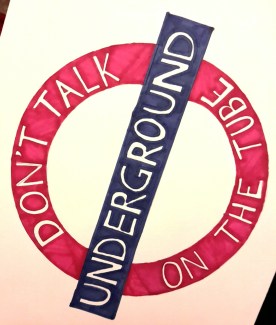
Don’t Talk on The Tube!

It is an unwritten, or more precisely, an unspoken rule, known instinctively to all Londoners.

As paramount to survival in the great metropolis as never waiting for the lights to change at a zebra crossing. As infamous as the knowledge that you are never more than 300ft from a Pret A Manger. As dependable as the unsmiling face of the barista who serves you your morning coffee.

You don’t talk on the Tube.

The London Underground is a peculiar environment, the commuter’s sanatorium. Suits and Backpackers metonymically mingle here, on the great equaliser of Public Transport.

The chaos of the station platform billows through the sliding doors and is hushed.

London delights in its ambivalence, its ambiguity, its contradiction. The chaos and the hush.

I am not a native Londoner, but I go in and out of the city enough to know how it works. I obey the rules. I stand on the right of the escalator, and when someone stands on the left when I’m in a rush, I tell them where to go. But one day, when a friendly Northerner sat down next to me and struck up a conversation, I couldn’t give him the cold shoulder. He needed someone to explain the rules to him, someone to bring him into the fold.

Northern Guy: “So, where you going today?”No Talking
Me: “On my way home.”

Northern Guy: “Ah ok. So is it always like this? People don’t talk to each other in London?”

Me: “No mate, people don’t talk on the Tube.”

Northern Guy: “Oh, I’m sorry. I’m from Leeds, ya see.”

Me: “It’s fine, you weren’t to know.”

Silence.

Of course I did this without making eye contact with him. That’s a rule I’m not willing to compromise on.

There is only one instance in which discussion is acceptable: transport delays. The horror of your train screeching to a halt, then the tell-tale crackle of the speakers…

The echoing muffle of the train attendant through the overhead speakers – incomprehensible to the average human – will drag the quietest of carriages into audible grumbles. This is the signal to look up from your LCD screen or paperback book, emit a murmured curse and make eye contact with another disgruntled commuter.

This announcement is permission, nay, an invitation to make acquaintance with your fellow travellers, through mutual exasperation. Because, although we all abide by the Unspoken Rule, the truth is, many of us wish we could be like the Northern Guy. We wish we could make friends with the people we are sardined in with. But Heaven forfend anyone who causes a delay.

It is a truth universally acknowledged that a single man in possession of a good fortune, must get to his meeting on time. If Jane Austen’s Mr Darcy were to run up to the closing doors of a Bakerloo Line train at Piccadilly Circus, he would definitely be one of those arrogant wankers who uses their briefcase to keep the doors from closing. And our modern-day Lizzie, already sat demurely in the carriage, would be righteously pointing out his solipsism to her giggling companion, as they shuttled towards Charing Cross.

Of course this is only fiction.

People don’t giggle on the Tube.

What Do Your Books Say About You?

This morning, I got to do something I haven’t been able to do in a long time. I woke up on my day off, turned on the light, picked up a book from my bedside table and read. The luxury of simply reading for the love of reading is one I have struggled to find time for since university.

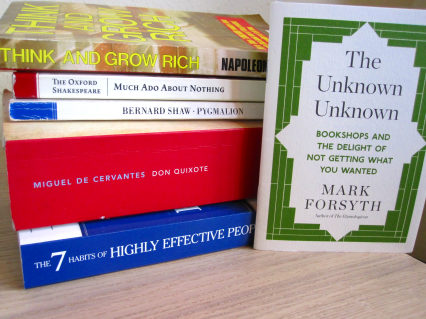
What do your books say about you? (I don’t mean behind you back.) The books currently sat on my bedside table could tell you a lot about me.Bookshelf


The Unknown Unknown, Mark Forsyth

Where did I get it? Received this in the post, adorned with a post-it, which read, “Thought you might enjoy reading this. Granny x” After receiving said delightful little package, I rang my Gran. She said it reminded her of my blog, the way I ramble, tangents veering off.

The tagline reads: “Bookshops and the delight of not getting what you wanted.” Do you know what a good bookshop is? Forsyth does. I haven’t been in a good bookshop since I was in New York and my wonderful aunt took me to a little treasure trove, where I discovered Verlyn Klinkenborg.

While I would happily tell you more about this little beautie, I’m concerned I might ruin the joy of an “unknown unknown.” It took less than an hour to read, and made me laugh out loud several times. Clever and witty without trying to be. Delightful in its purposelessness.

Bookmark: A page torn from my notepad at work. It is the beginnings of a short story I started writing during that last useless hour of a work day. Between half 4 and half 5, when no one really does anything but wait for the day to end. The Twilight Hour.

I have since continued writing the story on the computer at work – typing gives the impression of doing something productive – and I’m hoping to extend this into a collection of short stories. Might post a snippet on here at some point.


Don Quixote, Miguel de Cervantes

Where did I get it? Waterstones, Oxford.

This is one of the classics that follows you around. One of those epic, brick-like monstronsities that act as an adequate book-end until you work up the courage to dig in. Our friend Forsyth puts it thus in The Unknown Uknown:

“Tolstoy, Stendhal and Cervantes, these men follow me around. They stand in dark corners and eye me disapprovingly from beneath supercilious eyebrows. And all because I’ve never got round to reading their blasted, thousand-page, three-ton, five-generation, state-of-a-nation thingummywhatsits.

I’m taking on this monster. About 6 months in and I’m half way through. The adventures of the deluded knight, Don Quixote and his hapless copanion, Sancho Panza. It makes one giggle in a “Droll, Cervantes, very droll” kind of way. But there’s also the odd Dick Joke, which is nice.

Continue reading

Don’t Forget to Vote!


Voting Time.

People who have registered to vote but are planning not to.

Russell Brand is lobbying against voting. Ed Miliband met with him to discuss this issue, amongst others. One thing all politicians should be united on is encouraging everyone over 18 to vote. There is not enough of this.  Politicians are too busy saying “Vote for me,” when they should be saying “Vote.”

Vote. Full Stop.

There are thousands of people who are making the deliberate decision not to vote in this year’s election. Thousands of people saying “What’s the point? It doesn’t make a difference anyway.” Thousands of people feel powerless in the face of politics – disillusioned by bureaucracy, false promises, the same old faces.

I disagree with them.

I do not feel powerless.

I am instead daunted by the power my vote will have. When I began this project to educate myself in politics, I had no idea who I was going to vote for.  I knew very little about the party leaders I could vote for. Making an informed decision is something I decided to take seriously.

People who are still undecided this morning, you are taking this vote seriously. Why haven’t you decided yet unless you consider it to be an important decision? Take you time, consider your options, yes. But just make sure you vote today.

This year’s election may well make history. No one can really predict the outcome and that means that EVERY VOTE COUNTS.

Don’t forget to vote today.


Impolitic 4: News Vs Twitter


A discovery: politics is everywhere. Not ground-breaking as discoveries go, I grant you. But I suppose what I’ve really discovered, is that I must have been squandering huge amounts of energy avoiding politics before now. Across every radio and TV channel, the bonging of Big Ben was the signal to channel hop. So as soon as I decided to take an interest in politics, the veil was lifted and news appeared to spout from every screen and speaker within earshot.

The chiming of Big Ben is in many ways a sound comparable to the sounds and rhythms of every news bulletin. The perfect middle-class monotone of the newscaster. The well-rehearsed words of a speech. It’s emphasis practised and predictable.

One could hardly describe the average news segment as charismatic. But of course the general flatness in delivery, archetypal of the newscaster, is intentional. Their job is to remain impartial. Objectivity over subjectivity. The complete removal of emotive responsibility. It is the unwritten contract held between public and newscaster. Let the stories speak for themselves so that the audience may draw their own conclusions. Yet, despite this intentional removal of personality, we are still obliged to sit through the casual adlibbing of co-anchors, usually with little success at achieving nonchalance.

Twitter Vs. News

This impersonal approach hardly makes one enthused about watching the news either. No wonder the viewings are going down. You know what young people are like. Give us bright colours, made up words and sound effects. That’ll get the young’uns involved! Patronisation of my own age bracket aside, Twitter is the news channel for the younger generations.

TV is attempting to assimilate with the new media, displaying Twitter feeds alongside live coverage. The effect is somewhat confusing, and many viewers agree.

“Dave from Tumbleridge says, ‘Why is the Chancellor sharing half the screen with the thoughts of @iLivThruTwitter and #tags about his unkempt nose hair? It is distracting and inane.’ Thank you for your thoughts Dave…”

Continue reading