Book Review: “Eleanor” by Jason Gurley

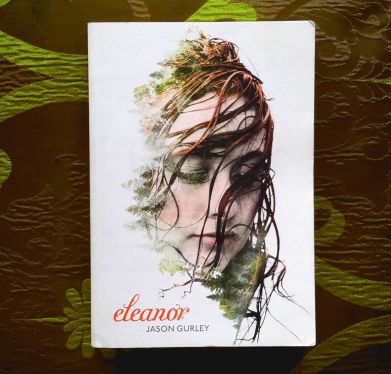
Eleanor

By Jason Gurley

eleanor 2

When tragedy befalls the Witt family, young Eleanor is left to pick up the pieces of her grief-stricken parents. And just when it couldn’t seem to get any worse, Eleanor is pulled out of her world and thrown, bewildered, into a netherworld, before being flung back again with terrible consequences. Like Alice falling through the rabbit-hole, Eleanor dangerously traverses the line between the real and the other.

“Eleanor” by Jason Gurley is classified as sci-fi/fantasy. It would be better to describe it as a realistic drama set against a surrealist dreamscape. Sci-fi and fantasy novels can reflect reality as much as a naturalistic novel, but fantasy looks at the world through a prism that promotes an alternative focus. Like walking through a corridor of distorted mirrors at a fairground, Gurley chooses to inflate or relocate aspects of known reality, forcing specific themes and ideas to come into sharper relief. In the case of “Eleanor”, it is the deeply complex experience of grief that thrives in the freedom of a sci-fi. Continue reading

Book Review: “The Long View” by Elizabeth Jane Howard

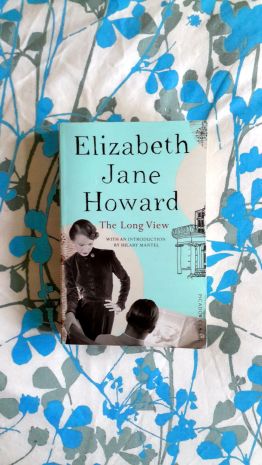
The Long View

By Elizabeth Jane Howard

the long view1

Mrs Fleming has no first name for the first half of the book and the second half of her life. Defined by her wifely title, she struggles to maintain a sense of self – a struggle no doubt undergone by hundreds of women in this era.

This beautifully told narrative is in reverse: starting in 1950 and ending in 1927. By reversing the chronology, Antonia Fleming’s moment of revelation at age nineteen, becomes the conclusion of the book. This rearrangement creates a feel similar to that of a mystery novel: we know what has happened already, but we don’t know how or why. We begin with an intelligent and sophisticated middle-aged woman, living in London, trapped in an unhappy marriage, hosting dinner parties she doesn’t want with guests she doesn’t like. As the decades retreat, the veils are drawn back, we eventually approach her vulnerable 19-year-old self – a girl so capable of love and intelligent thought but drawn towards an unhappy future, almost inevitably.

It is for this reason that Antonia’s revelation makes both a satisfying and bittersweet end to the novel. I feel the urge to re-read the book immediately, but this time starting at the end, so that I can spot the clues and connections that bring the narrative together. The book is intelligently crafted, and such an endeavour would indeed prove fruitful.

It is beautifully written, although occasionally abstruse. The narrative voice is excellently used to create different characters within the text rather than constantly breaking the flow with dialogue. Howard’s ability to create their different voices is a treat. There is also a nod to formalism in its method of description, keeping the imagery far and away from clichéd or boring observation.

The book’s best feature is the way in which Mrs Fleming’s intimate thoughts are communicated fluidly and with such a degree of empathy that they cease to be fictional. Howard’s strength is finding the words and the cadence with which to communicate untold and often unspeakable feminine sensations.There is an innate femininity to many of the feelings and situations addressed by Mrs Fleming’s story. Told with respect and sensitivity, she reveals the humanity¸ not just the femininity, in the process, because they are made to be understood.Rather than diminishing or reducing female emotion to hysteria or irrationality, as is often the case in literature and life, we are given entry into the innermost workings of a feminine mind. Complex, certainly, but ultimately honest.

“She had forgotten these minute inversions of feeling, that with certain kinds of experience shift all the contours of any settled view.”


Book Review: “Good Omens” by Terry Pratchett & Neil Gaiman

Good Omens

By Terry Pratchett & Neil Gaiman

good omens 1

The world is coming to an end. The armies of Heaven and Hell are assembling. The Four Horsemen are gathering. And the Antichrist is playing make-believe with his friends and his hell-hound, Dog. An unlikely group of heroes converge on Lower Tadfield, Oxfordshire. Agnes Nutter’s prochecies are finally coming true, but this “ineffable Plan” business isn’t quite what everyone expects…

Have you ever been enjoying a book so much that you couldn’t put it down, but then found yourself reaching the end too soon and had to slow down so the adventure could continue for just a bit longer? “Good Omens” is the first book that has ever made me do this. Rushing towards its conclusion too quickly, I wanted to stay on the journey. I didn’t want it to end.

The characters, the language, the narrative – flippant and somehow bluntly logical in the face of utter nonsense. It is vivid, colourful and hilarious.

It’s a style I’ve grown to love from reading Pratchett’s Discworld series, but it is my first reading of a Gaiman  story. I couldn’t tell you when it was one or the other that had the reins from chapter to chapter. The narrative voice was consistent throughout and I honestly felt like I was reading a Pratchett. But I will definitely be getting stuck into some Gaiman very soon as a result of reading this book.

This is one of those books you could keep going back to and reading over and over again and finding more and more hidden gems that will keep surprising you for years to come. The imaginative powers of these two brilliant authors are seemingly endless. Endless and bottomless. Keep plumbing the depths of this book and the world they create will only get bigger and brighter. Whether you decide to focus on the story, the clever use of language and syntax or the ideas that bounce around like a rubber ball inside a perpetual motion machine, the delights do not stop coming.

As far as I’m concerned, this is the essence of what fiction should be. A world of play and an open invitation.

In this present moment, I wish I weren’t writing this blog; I wish I were reading “Good Omens” by Terry Pratchett & Neil Gaiman. A book that proves these two men deserve the title of Legend. Modern philosophers and linguistic philanthropists, this book is a gift for me and you and generations to come.


P.s. I finished reading my copy two days ago. I gave that same copy to a friend yesterday. Pass on the joy!

Book Review: “The Book Thief” by Markus Zusak

The Book Thief

By Markus Zusak

the book thief

This is a beautiful book. Exquisitely heart-breaking.

Germany is in the hands of the Führer, and Liesel Meminger is a book thief. Both Hitler and Liesel know that words have power. Words can save a person’s soul or inspire people to do unspeakable things.

In this novel, Markus Zusak is our omnipotent and benevolent wielder of words. His ability to capture the imagination is powerful and gentle. Master of the concise metaphor. I was drawn into the Book Thief’s world within the opening paragraphs and could not put it down. It begins simply and proceeds in uncomplicated terms. Its gentle twists and turns develop into a fully formed and complex story without you even realising. But I will not allow myself to over-analyse; I wish to leave this story unbroken.

Liesel stole books. And Death was her friend. Discover the rest for yourself.

Re“Vamp”ing The Classics: Book Vs. Screen

For anyone who missed it being published on Clamour’s website, here’s the article again (Click here to view on Clamour):


Are we too precious about the classics, or is the literary canon being sullied by modern adaptation and blasphemous reinvention?

Is this a question of artistic integrity or snobbery? Or is it nothing so high-flown, and merely a signal for change in social approaches to literature and the arts in general? In an age where the big screen is constantly beating books in the popularity contest, the relationship between these two art forms is changing. Slap a new cover on an old book, with the familiar faces of a recent screen adaptation, and that book will fly off the shelves that before had only been gathering dust.

Two recent examples that have undergone a screen ‘revamp’ are “War & Peace” by Leo Tolstoy, in the much acclaimed BBC adaptation in January of this year, and the Jane Austen inspired “Pride & Prejudice and Zombies” by Seth Grahame-Smith, released as a feature film in February.

book v screen V1 small

Reworking literature is not a new idea. Satire has always existed, ever since there were people making art, from Ancient Greece to the present day. Satire, parody, homage and pastiche – the oldest forms of criticism or veneration. What, then, makes these two examples of particular interest? What new trend are they evidencing? Continue reading

Book Review: “The Noise of Time” by Julian Barnes


The Noise of Time

By Julian Barnes

noise of time book

5-stars

I was already a fan of Julian Barnes before I read this book. But I was familiar with his more overtly humourous titles – “Flaubert’s Parrot” and “A History of the World in 10 1/2 Chapters”. While this new novel is still unmistakably stamped with Barnes’ wry style, it is of a blacker kind than I had previously encountered.

“The Noise of Time” tells the story of real life Russian composer Dmitri Shostakovich, during the twists and turns of the Russian Revolution. It is a tale of one man’s struggle, and the problem of artistic freedom versus artistic integrity. You might think – or hope – that the first will bring about the second. If the artist is free to create as he wishes, then surely what he produces will, if he possibly can, be naturally something with integrity. Not so, when the grip of Communism has so thoroughly distorted the nature of what it means to be free.

“Let Power have the words, because words cannot sustain music. Music escapes from words: that is its purpose, and its majesty.”

The distortion of language, of terms like freedom and truth, make the role of musician in our historical protagonist an interesting lens through which to view Russia at that time. Even if words have been betrayed, perhaps there is still hope for music. Perhaps music can be heard above the din of propoganda, and deliver secret messages to those willing to hear. But if Shostakovich’s music could reach worthy ears, would political “truths” and the ghastly practise of Revisionism so dismantle the Russian landscape and its people, that both the man and his music would be drowned out by the noise of time?

And in amongst the big political and cultural questions Continue reading

Job Success -The Cover Letter Resolution

As I wile away the time between being an Almost-Adult and being a Finished Adult – perish the thought – I have gotten myself a part-time job in a bookshop. It’s not a life time goal, but a facilitator for the many I hold. For, like it or not, money makes this giant sphere rotate around an off-vertical axis. Or something more catchy than that. So, I’ve got a job at a bookshop, which is already infinitely better than counting money in a department store. Books are my thing.

As some of you may recall from previous posts, the process of filling out job applications and writing covering statements is a task I much lament. I therefore took a bit of a different tack with my cover letter on this occasion and, evidently, it worked…


To Whom It May Concern,

To be blunt, I really want to work in [Big-Brand Bookshop]. I’m looking for a part-time position with flexible hours, and I’m happy to work weekends, and a position in your shop would be perfect for me.

I’ve been a book lover ever since I can remember. I remember the first book I ever read; it was called Look, and on each page was one word, “Look.” It was my first book, what do you want from me? I remember the first time I read a whole book in one day. It was Fantastic Mr Fox, by Roald Dahl – that’s a big achievement when you are seven years old. I remember my older sister reading Mr Men books to me when I couldn’t sleep. I remember racing against my sister to finish the latest Harry Potter. I remember staying up all night, because I couldn’t put down The Handmaid’s Tale, by Margaret Atwood. I remember the sense of discovery I felt when Continue reading

What Do Your Books Say About You?

This morning, I got to do something I haven’t been able to do in a long time. I woke up on my day off, turned on the light, picked up a book from my bedside table and read. The luxury of simply reading for the love of reading is one I have struggled to find time for since university.

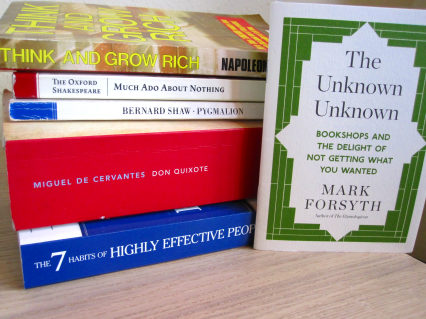
What do your books say about you? (I don’t mean behind you back.) The books currently sat on my bedside table could tell you a lot about me.Bookshelf


The Unknown Unknown, Mark Forsyth

Where did I get it? Received this in the post, adorned with a post-it, which read, “Thought you might enjoy reading this. Granny x” After receiving said delightful little package, I rang my Gran. She said it reminded her of my blog, the way I ramble, tangents veering off.

The tagline reads: “Bookshops and the delight of not getting what you wanted.” Do you know what a good bookshop is? Forsyth does. I haven’t been in a good bookshop since I was in New York and my wonderful aunt took me to a little treasure trove, where I discovered Verlyn Klinkenborg.

While I would happily tell you more about this little beautie, I’m concerned I might ruin the joy of an “unknown unknown.” It took less than an hour to read, and made me laugh out loud several times. Clever and witty without trying to be. Delightful in its purposelessness.

Bookmark: A page torn from my notepad at work. It is the beginnings of a short story I started writing during that last useless hour of a work day. Between half 4 and half 5, when no one really does anything but wait for the day to end. The Twilight Hour.

I have since continued writing the story on the computer at work – typing gives the impression of doing something productive – and I’m hoping to extend this into a collection of short stories. Might post a snippet on here at some point.


Don Quixote, Miguel de Cervantes

Where did I get it? Waterstones, Oxford.

This is one of the classics that follows you around. One of those epic, brick-like monstronsities that act as an adequate book-end until you work up the courage to dig in. Our friend Forsyth puts it thus in The Unknown Uknown:

“Tolstoy, Stendhal and Cervantes, these men follow me around. They stand in dark corners and eye me disapprovingly from beneath supercilious eyebrows. And all because I’ve never got round to reading their blasted, thousand-page, three-ton, five-generation, state-of-a-nation thingummywhatsits.

I’m taking on this monster. About 6 months in and I’m half way through. The adventures of the deluded knight, Don Quixote and his hapless copanion, Sancho Panza. It makes one giggle in a “Droll, Cervantes, very droll” kind of way. But there’s also the odd Dick Joke, which is nice.

Continue reading

The Perfect Pen

As a writer, I have certain conditions in which I like to work. According to my new writing guru, Verlyn Klinkenborg, creating conditions for your own creative process will only become barriers in the long run.

“Anything you think you need in order to write –
Or be “inspired” to write or “get in the mood” to write –
Becomes a prohibition when it’s lacking.
Learn to write anywhere, at any time, in any conditions,
With anything, starting from nowhere.
All you really need is your head, the one indispensable requirement.” (80)

As much as I see the reason in VK’s “short sentences”, I am struggling to follow through on this. There is a specific pen I like to write with. I recently lost that pen and bought a replacement today. Thankfully, it is stocked in most highstreet stationers. What’s so special about this particular pen? Well, for starters, it is the perfect shade of blue. I find page upon page of black biro a depressing spectacle. Blue offers a far more pleasing aesthetic, but it is not too bright of a blue as to be overstimulating… As I’m writing I’m starting to see how picky this sounds. But I shall continue anyway. In addition, this pen has remarkably little resistance on the page. My hand can glide along each line and a beautiful river of letters transfers effortlessly onto the crisp white paper.

page 1

And it’s not just the pen. I don’t like starting a new notepad. I like being able to flick through previous pages, read the occasional paragraph and think, “Man, I write some good stuff.” Those previous pages are a comforting, midnight-blue blanket of prose. Those paragraphs give me the confidence to turn to the dreaded empty page and begin. As a result, there is an old notepad I refuse to throw away because some fantastic essays began in those pages.

And beyond the raw materials, the environment has to be right too. Firstly, excellent light. Not yellowy, low-energy lamps, whose rays fail to chase away the darkening sky as you toil into the night.  Of course, a desk and comfortable chair are a must. And then there’s the noise factor. Everybody likes to work differently. Some people want absolute silence. Others blast heavy metal through their headphones. I need the right amount of ambient noise. Not silence, not heavy metal, but somewhere in between. I want friendly chatter, but not raucous laughter. A reassuring, indistinct melee of noise. I want to hear that buzz of life that reminds me there is existence beyond the realms of the word counter. The ground floor of UEA library was my perfect work zone. Having visited some local libraries recently, I can now say I miss university more than ever.

I am currently battling with drama school applications and that means Personal Statements. Yes, that dreaded task has rolled around again. There is already a post dedicated to my hatred of this task – the whole concept in fact – so I shan’t rant any further. What I will say is this: I have just acquired a visitor’s pass to Reading University library and a brand new pad of paper. I now sit with an old notepad, a new notepad, borrowed wifi and my favourite blue pen. Something old, something new, something borrowed, and something blue.

And so, with a hint of panache and some abbreviation, I can now say…

P.S. You Are My Bitch.

screenshot 2


cropped-absy-logo-large-1-bold-small-s.png

Book Review: “Several short sentences about writing” by Verlyn Klinkenborg

Several Short Sentences About Writing

by Verlyn Klinkenborg
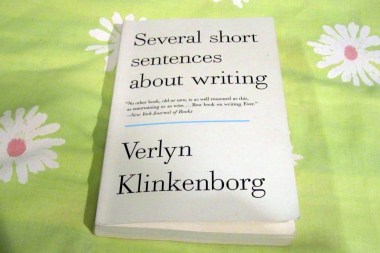
book 1

“The question isn’t, can the reader follow you?
That’s a matter of grammar and syntax.
The question is, will the reader follow you?” (128)

I’ve never written a book review, but I think it goes something like this: a brief description of subject, author and intended audience; list good and bad points; and a couple of pithy quotes.  I shall largely adhere to this format.  Though do forgive me if I find the implied rules of this genre too confining for my wild artistic tendencies.

So, to begin: a brief description of subject, author and intended audience

This is a book written for writers by a writer about writing.

Too brief, perhaps.

While this text is applicable to writers of any experience or style, I think it is particularly useful for those at a turning point in their career as a writer – professional or otherwise.  You might be taking on a new genre, or adapting to an alternative medium – you wouldn’t write an internet blog like you would a private diary entry, for example. Or you might be moving from school to university, or university to the working world, and experiencing the imperative to evolve as a writer as well as a person. It is this last writer to whom I particularly recommend this book.

I have personally struggled with the step up from school to university writing. It is a transition that leads to anxiety. Be more mature, be more sophisticated. Be “better”. While university is the place to improve and mature, a better writer grows, not by anxiously reaching, but by exploring and experimenting. Don’t be bogged down by the “rules” of writing as they were dogmatically put to you in the early years of education. Respect the rules, of course, but don’t be afraid to challenge them. Verlyn Klinkenborg is emphatic on this point. “And yes, you may begin a sentence with ‘but.’” (119)

(From here-on, I shall refer to the author as VK. Younger readers: feel free to insert drinking puns.)

A revised brief description: this book is for the reader who is struggling to find her voice.

good and bad points

I am loath to tritely fulfil this requirement.  I shall rather offer a few points of interest:

On VK’s style: he really does practise what he preaches. Expect many short sentences about writing.

Don’t be precious about clichéd notions of “what it is to be a writer”. In fact, don’t be precious about clichés, full stop.

“A cliché is dead matter.
It causes gangrene in the prose around it, and sooner or later it eats your brain.” (45)

He isn’t a romantic. There will be no coddling.

VK follows the recent trend of using “her” as the generic pronoun in his text. I’m trying it out. I still find it odd on the ear, but then perhaps I’m antifeminist.

His style isn’t for everyone. He makes no exceptions and allows no excuses.  But he does not patronise you.  His is a clear, forthright voice.  He does not seek to trick or beguile, and though witty at times, his humour is curt at best. Some may find him abrasive, others, refreshing.

At times you will feel like you are back at school. But, as I have already discussed, re-examining the confining and sometimes misleading rules of English school teaching is crucial. This is how you extinguish anxiety and allow your own voice to emerge confidently.

and a couple of pithy quotes.

How about just one:

“You’re holding an audition.
Many sentences will try out.
One gets the part.
You’ll recognize it less from the character of the sentence itself
than from the promise it contains – promise for the sentences to come.” (101)


Reference:

Klinkenborg, V. Several short sentences about writing (New York: Vintage Books, 2013)

Further Reading:

“Several Short Sentences About Writing” Reviewed by Vinton Rafe McCabe (New York Journal of Books, 2012)